How to use sunscreen in your routine
Updated · Unboxia, Dublin · 4 min read
Knowing how to use sunscreen comes down to one rule: make it the last step of your morning skincare, after your moisturiser and before any make-up. Use roughly half a teaspoon for your face and neck, let it settle for a minute or two, and top it up through the day. A light Korean SPF50 keeps that final step easy to stick to.
Where does sunscreen go in your routine?
Sunscreen goes last in the morning, once the rest of your skincare has sunk in. Cleanse, apply any watery toner or essence, press in your serums, seal everything with a moisturiser, then finish with SPF as the final layer. Give your moisturiser a minute or two to settle first, so the sunscreen sits evenly instead of pilling.
A simple morning order looks like this:
- Wash your face and gently pat it until barely damp.
- Sweep on a toner, or a hydrating essence like Rovectin's Aqua Hyaluronic Essence.
- Work your serums in and give them a moment.
- Follow with a moisturiser, then pause a minute or two.
- Apply sunscreen as the last step, then make-up if you wear it.
If you follow a longer routine with actives, the same rule holds: sunscreen always comes after the rest, never before. It is the protective layer that sits on top of everything else.
How much sunscreen should you apply?
Most people use too little, which quietly lowers the SPF they actually get. For the face and neck, aim for about half a teaspoon, or the classic two-finger length squeezed along your index and middle fingers. Spread it evenly rather than rubbing it right in, and do not forget the edges people miss: ears, hairline, the sides of the neck and the backs of the hands. If you are heading outdoors for the day, a shot-glass amount covers the rest of your exposed skin.
When and how often should you reapply?
Top up roughly every two hours while you are out in daylight, and sooner if you have been swimming, sweating or towelling off. Indoors and away from windows, one morning application usually sees you through. The easiest way to reapply over make-up is to press a fresh layer on with clean fingers or a cushion rather than rubbing, so you do not disturb what is underneath. Keeping a travel-size SPF in your bag makes the midday top-up far more likely to happen.
What do SPF and PA ratings mean?
SPF measures how well a sunscreen handles UVB, the shorter rays behind sunburn, while the PA rating measures UVA, the longer rays that reach deeper into skin. PA is a Korean and wider Asian scale, shown as PA+ through PA++++, where more plus signs mean stronger UVA cover. A broad-spectrum SPF50 with a high PA rating gives you cover across both kinds of ray, which is why so many Korean formulas pair the two.
Does sunscreen replace the rest of your routine?
No. Sunscreen is a protective final layer, not a stand-in for the steps underneath it. Keep your cleanse, hydration and moisturiser in place and add SPF on top. If your skin feels greasy under sunscreen, a lighter, sheer formula usually sits better than a rich cream; if it feels tight, add a hydrating step from the lightweight serums first. Pairing SPF with a gentle morning routine, the kind covered in our guides on how to use niacinamide and how to use centella, feels more comfortable than relying on sun protection on its own.
How to choose your first Korean sunscreen
Choosing your first Korean sunscreen comes down to the finish you will happily wear every day. A sunscreen only helps if you actually reach for it, so texture matters as much as the number on the label.
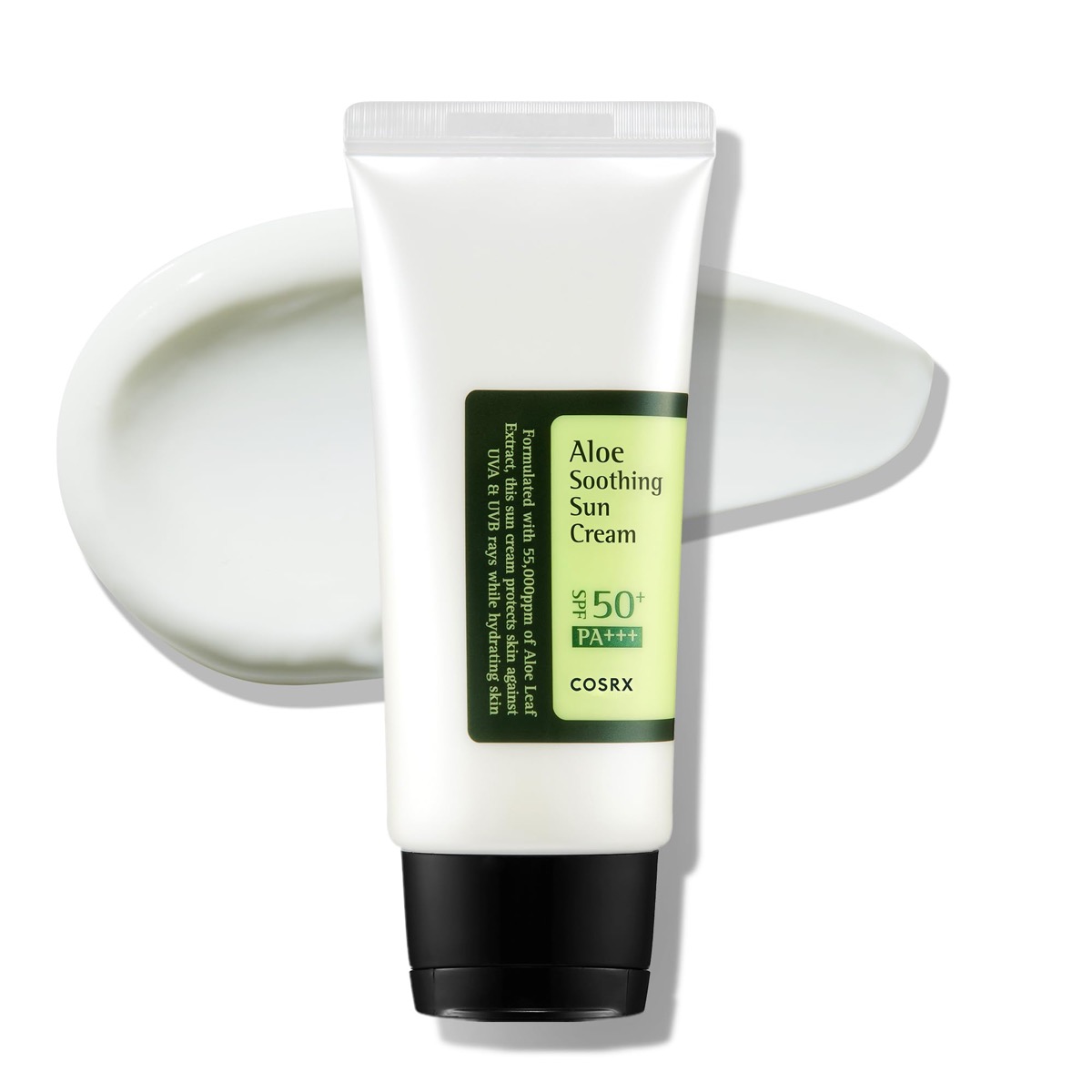
- For a comforting, cream finish that doubles as a light moisturiser, the COSRX Aloe Soothing Sun Cream SPF50 is made with aloe and rated PA+++. COSRX describes the formula as lightweight, with no white cast.
- For oilier or combination skin, or anyone who dislikes a white cast, the COSRX Ultra-Light Invisible Sunscreen SPF50 has a sheer, invisible finish and carries the higher PA++++ rating.
Whichever you choose, apply it generously as your last morning step and top it up through the day. If you would rather build your SPF around a particular cream, browse the full range of moisturisers and add sunscreen as the finishing layer.
Questions people ask
Do you apply sunscreen before or after moisturiser?
After. Sunscreen is the final step of your morning routine, so apply it once your moisturiser has settled for a minute or two. Putting SPF on last lets it sit evenly on the surface, where it can do its job, instead of being diluted under heavier creams.
How much sunscreen should I use on my face?
About half a teaspoon, or a two-finger length along your index and middle fingers, for the face and neck together. Most people apply far less than this, which lowers the protection they actually get. Spread it evenly and include your ears, hairline and neck.
How often should you reapply sunscreen?
Roughly every two hours while you are out in daylight, and straight after swimming, sweating or towelling off. Indoors and away from windows, one morning application is usually enough. Press a fresh layer over make-up with clean fingers rather than rubbing it in.
What does the PA rating on Korean sunscreen mean?
PA measures how much UVA cover a sunscreen gives, on a scale from PA+ to PA++++. More plus signs mean stronger cover against the longer UVA rays. SPF, by contrast, rates UVB. A broad-spectrum SPF50 with a high PA rating covers you across both.
Can I wear Korean sunscreen under make-up?
Yes. Let your sunscreen settle for a minute or two, then apply make-up as usual. A sheer, invisible formula tends to sit best under foundation, while a cream SPF suits a bare-skin morning. To top up later, press more sunscreen on over your make-up rather than rubbing.